09/01/26
Sometimes a topic begins as a thought.
Then it becomes a blog post.
And occasionally, it gets the chance to become a conversation.
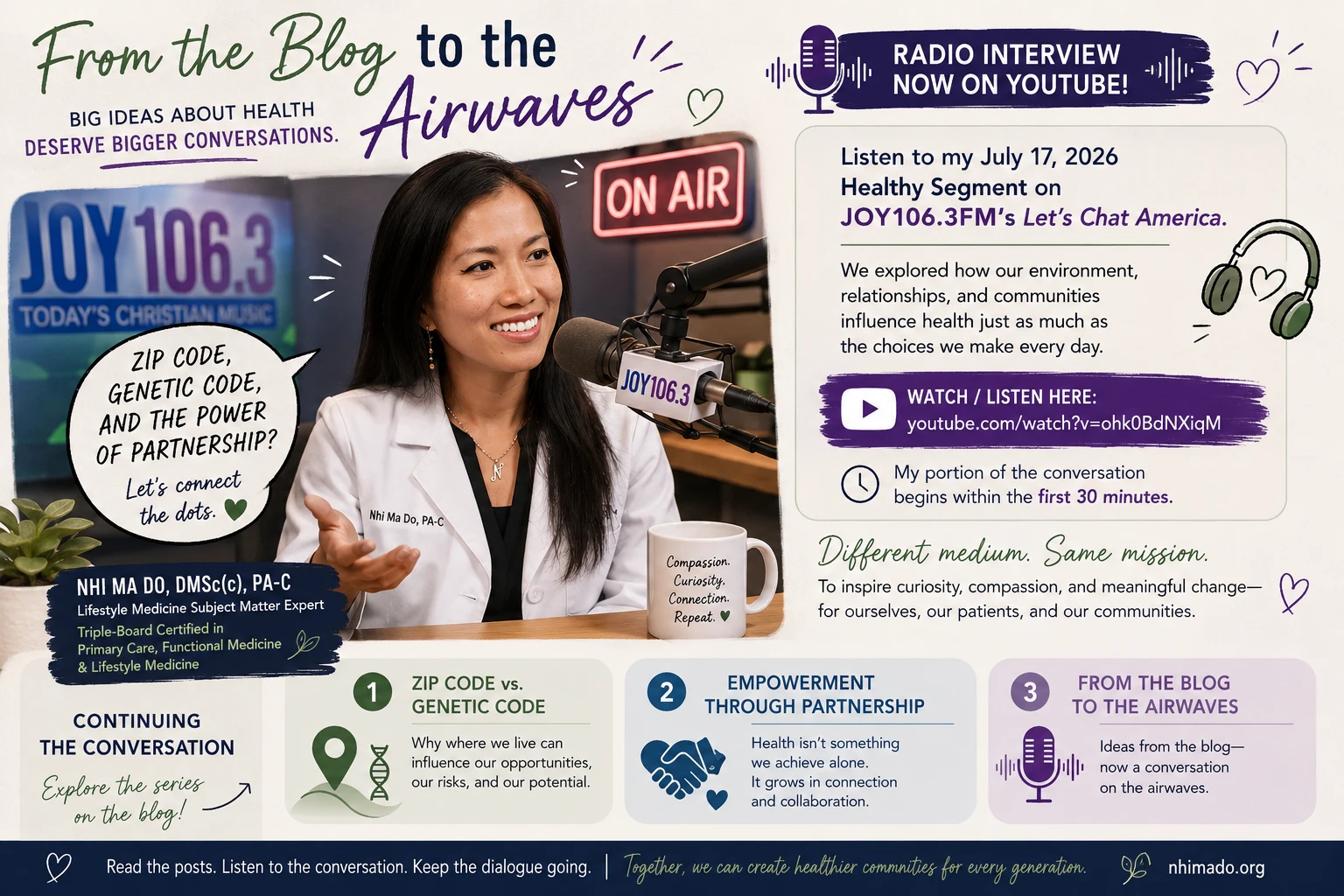
This summer, I had the opportunity to bring one of those conversations to the airwaves during my July Healthy Segment on JOY106.3FM’s Let’s Chat America.
🎙️ The recording is now available on YouTube as of last month:
https://www.youtube.com/watch?v=ohk0BdNXiqM
My portion of the conversation begins within approximately the first 30 minutes of the recording.
And while I have written before about both “Zip Code vs. Genetic Code” and “Empowerment Through Partnership,” this interview gave me an opportunity to step back from those written pieces and talk about what these ideas can actually look like in real life.
Sometimes Health Starts with a Better Question…
One of the things I enjoy most about conversations outside of the traditional clinical setting is the opportunity to slow down and ask questions that don’t always fit neatly into a medical visit.
What if we stopped looking at health exclusively through the lens of diagnoses, medications, lab values, and individual behaviors?
What if we also became curious about the context surrounding the person sitting in front of us?
That was at the heart of our July conversation.
Not simply:
“What can we do to become healthier?”
But:
“What makes health possible—or difficult—in the first place?”
That distinction has become increasingly meaningful to me throughout my work in primary care, Functional Medicine, Lifestyle Medicine, and my doctoral training.
The Conversation Behind the Conversation…
Preparing for this interview actually made me reflect on how many different threads have come together throughout my professional journey.
My work in senior primary care has taught me that a recommendation can sound wonderfully simple on paper and become much more complicated once we understand someone’s circumstances.
My Functional Medicine and Lifestyle Medicine work has continued to reinforce the importance of looking beyond a single disease or behavior.
And my doctoral coursework has challenged me to think more deeply about communities, population health, and the conditions that influence health long before someone walks through the doors of a clinic.
Those experiences have changed the way I listen.
Instead of immediately asking:
“What intervention does this person need?”
I find myself asking:
“What do I need to understand first?”
That might mean understanding someone’s daily routine.
Their support system.
Their access to food.
Their transportation.
Their stressors.
Their environment.
Their priorities.
Or simply what matters most to them.
Sometimes the most important clinical information isn’t found in the chart.
It’s found in the story.
Why I Wanted to Have This Conversation on the Radio
Radio is an interesting medium for talking about health.
There isn’t a physical exam.
There isn’t a blood pressure cuff.
There isn’t a medication list in front of you.
There is simply a conversation—and hopefully, a listener somewhere thinking:
“I never thought about it that way.”
That is what I hoped this segment could do.
Not overwhelm listeners with another list of things they should be doing.
Not suggest that health is simply a matter of having enough discipline.
And not imply that everyone has the same starting line.
Instead, I wanted to open the door to a broader understanding of health—one that acknowledges both the choices we make and the circumstances in which we are making those choices.
A Different Kind of Prescription
We often think about prescriptions as something that comes from a clinician.
A medication.
A referral.
A treatment plan.
But what if one of the most powerful “prescriptions” we can offer is sometimes connection?
A trusted person to walk with.
A community resource.
A healthcare professional who listens.
A caregiver who understands.
A neighborhood that feels safe.
A place where someone can belong.
A conversation that replaces shame with curiosity.
These aren’t replacements for medical care.
They are part of the larger ecosystem that allows people to actually benefit from the care we provide.
And this is where I think Lifestyle Medicine has such an important role to play: not simply asking people to change, but helping us think about how we can create conditions that make change more realistic and sustainable.
And Yes—There Is a Personal Side to This
There is something else I shared during the interview that I don’t think I would have captured quite the same way in a written article.
My own life has given me plenty of opportunities to think about the relationship between place and health.
My family lives on the opposite coast of Florida, and I travel back and forth across the state regularly.
Those long drives have given me a lot of time to observe how quickly communities can change—sometimes within just a few hours.
Different neighborhoods.
Different resources.
Different landscapes.
Different rhythms of daily life.
And somewhere along those drives, I began thinking more deeply about how the places we call home can quietly shape our health stories.
Sometimes you don’t fully appreciate a concept until you can see it playing out around you.
So, What I Hope You Hear
If you have already read my previous posts on these topics, I don’t want this interview to simply give you the same message in a different format.
Instead, I hope you hear the conversation behind the concepts.
The curiosity.
The questions.
The practical realities.
The reminder that health is personal—but it is never entirely individual.
And perhaps most importantly, I hope you hear an invitation to look at yourself, your patients, your family members, and your community with a little more curiosity and a little less judgment.
Because sometimes the most meaningful question isn’t:
“Why aren’t they doing better?”
It is:
“What would help make doing better possible?”
That is a very different conversation.
And I think it is one worth having.
🎙️ Listen to the Interview
The July 17, 2026 Healthy Segment of Let’s Chat America on JOY106.3FM is now available to watch on YouTube.
My segment is featured within approximately the first 30 minutes of the recording.
If you listen, I’d love for you to share:
What question did this conversation leave you thinking about?
Because sometimes a good health conversation doesn’t end when the microphone turns off.
Sometimes, that’s where it begins...
Until next time,
~Nhi Ma Do, PA-C, FMCP-M, DipACLM